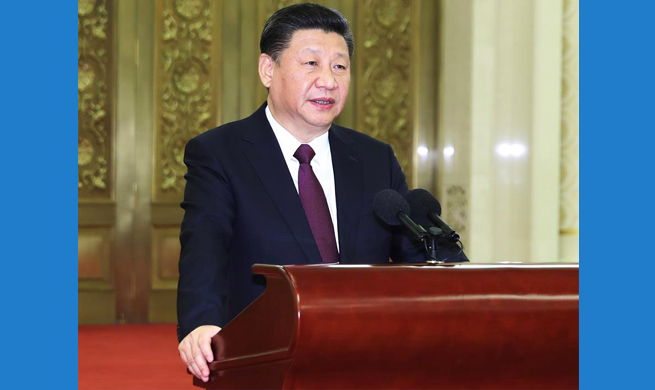
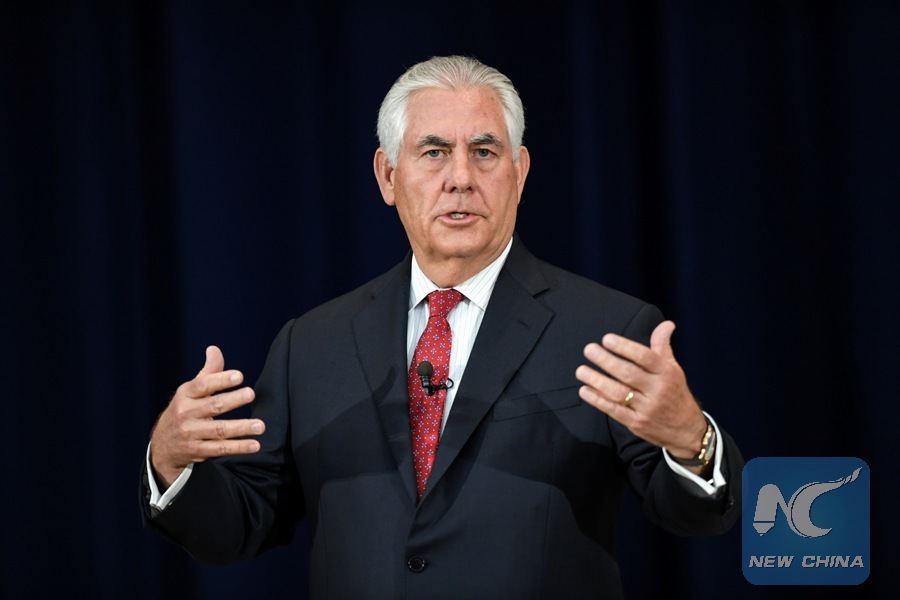
File photo: U.S. State Secretary Rex Tillerson makes his second address to all Department employees in Washington D.C., capital of the United States, May 3, 2017. (Xinhua/Bao Dandan)
WASHINGTON, Dec. 28 (Xinhua) -- The United States, while maintaining "a poor relationship" with Russia, still needs to work with Russia in areas of mutual interests including Syria, said U.S. State Secretary Rex Tillerson on Thursday.
Washington and Moscow remained widely confrontational this year amid the ongoing investigation of Russia's interference in the U.S. presidential election, the diplomatic row and the disagreements over issues including the eastern Ukraine.
Russian Foreign Minister Sergey Lavrov has denied evidence exists of any Russian interference in the U.S. elections in 2016. The statement came after charges were filed in the U.S. against former aides of the Trump campaign.
"The United States today has a poor relationship with a resurgent Russia," wrote Tillerson in a commentary published in the New York Times.
"There cannot be business as usual with Russia" with absent a peaceful resolution of the Ukraine situation, the top U.S. diplomat added.
Earlier this month, the United States has again moved to confront Russia over the eastern Ukraine issue, preparing to sell advanced weapons to Ukraine and asking Russia to ease violence in eastern Ukraine.
Reacting to the U.S. arms sale decision, the Russian Foreign Ministry said that it will lead to "new bloodshed."
In the article reviewing the U.S. foreign policy, Tillerson also noted that the United States still needs to work with Russia where mutual interests intersect, and "nowhere is that more evident than in Syria."
Tillerson acknowledged Russia's commitment to the United Nations-backed Geneva political process to achieve peace in Syria.
Earlier this month, the latest round of Geneva peace talks on Syria ended without any "real negotiations."
In parallel with the Geneva talks were several rounds of talks in Astana, which were supported by Russia, Turkey and Iran. The Astana talks achieved the de-escalation zones deal for the cease-fire in four major hotspots in Syria.