
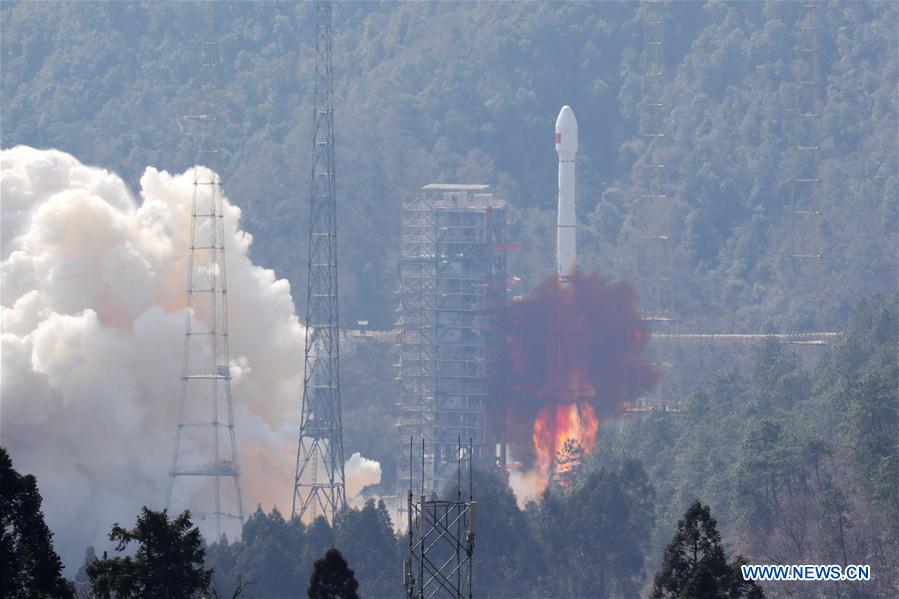
China sends two satellites into orbit on a single carrier rocket for its domestic BeiDou Navigation Satellite System (BDS) in Xichang, southwest China's Sichuan Province, Feb. 12, 2018. The twin satellites, which form a network with four previously launched BeiDou-3 satellites, were the fifth and sixth satellites in the BeiDou-3 family. (Xinhua/Liang Keyan)
XICHANG, Sichuan, Feb. 12 (Xinhua) -- China sent two satellites into orbit on a single carrier rocket for its domestic BeiDou Navigation Satellite System (BDS) on Monday.
The twin satellites, which form a network with four previously launched BeiDou-3 satellites, were the fifth and sixth satellites in the BeiDou-3 family. They entered orbit more than three hours after the launch from the Xichang Satellite Launch Center in southwest China's Sichuan Province.
All of the BeiDou satellites were launched from Xichang and all of the missions were successful, said Dong Chongqing, Party secretary of the launch center.
Set up in 1970, Xichang Satellite Launch Center's major task is to launch geostationary satellites. It has launched more satellites than other centers in China.
The twin satellites were carried by the Yuanzheng-1 upper-stage on the rocket. Yuanzheng-1, or Expedition-1, is an independent aircraft installed on the carrier rocket with the ability of sending one or more satellites into different orbits in space.
The launch was the 267th mission for the Long March rocket family.
China will send 18 BeiDou-3 satellites around the end of 2018 with Long March-3A rockets, according to the country's schedule.
Among eight of its 14 planned missions in 2018, the Long March-3A rocket will send twin BeiDou-3 satellites into space, said Cen Zheng, rocket system commander-in-chief of the mission.
"China developed a new generation of platform for navigation satellites that enable a single rocket to send two or more satellites into space in 2010," said Wang Ping, the chief designer of BeiDou-3 family. "The lightweight platform is easy to assemble and versatile, which fits the mission to send satellites on one rocket."
Named after the Chinese term for the Big Dipper, the BeiDou project was formally launched in 1994. It began to serve China in 2000 and the Asia-Pacific region at the end of 2012.
By around 2020, when the BDS goes global, it will have more than 30 satellites.