HANGZHOU, April 26 (Xinhua) -- A 4.5-km rail line has paved the way to wealth for a remote village in east China's Zhejiang Province.
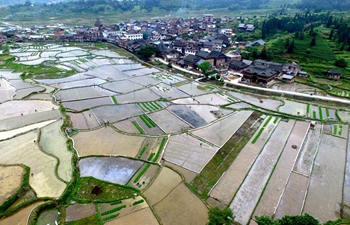
The narrow-gauge railway, which opened three years ago, has taken tens of thousands of tourists to Lujia village, hidden amid a vast area of bamboo forests in northern Zhejiang.
Lujia was the shooting location for the Oscar-winning film "Crouching Tiger, Hidden Dragon," but the movie's fame had not passed on to the village until a small tourist train came to town.
With only five carriages, the train travels at less than 10 km per hour, but passes through 18 themed farms. Passengers enjoy the beauty of tea garden, bamboo groves, flowers and fish ponds along the route. Every year, the train brings in more than 250,000 tourists.
Li Yali from northwest China's Gansu Province moved to Lujia after getting married a decade ago. "The village was very poor and full of adobe houses when I came here," Li said. Instead of living in the village, she and her husband rented a house in town.
"The living conditions were rather bad when I was elected in 2011," said Zhu Renbin, Party secretary of the village. At that time, a provincial campaign to improve the environment in villages was under way, and Zhu was determined to turn the lives of local residents around.
Rows of trash bins were placed at the doors, while polluted rivers and dirt roads were cleaned and rebuilt. "The face of our village changed dramatically within a year," said Zhu.
In 2013, China's central government first raised the idea of "family farms," which Zhu believed could be a solution for the village. "The beautiful scenery should be transformed into wealth shared by all residents," he said.
Now tourism has become the main source of income for the village, and the train not only brings in tourists, but also brings back migrants from the village who had been working away from home. Li has moved back to work as a tour guide on the train. "My husband is still working in town, but of course we will stay if we can make a living here," she said.
Lou Jian, 23, plans to come back home to work as a barista after college graduation. "Although I can only make 3,000 yuan (475 U.S. dollars) a month, I'm sure we'll have a bright future here."
According to Zhu, the village's collective assets exceeded 100 million yuan in 2017 and the value of each share of the tourism company, in which the village holds a 49-percent stake, has surged to 19,800 yuan in 2017 from 375 yuan in 2014.