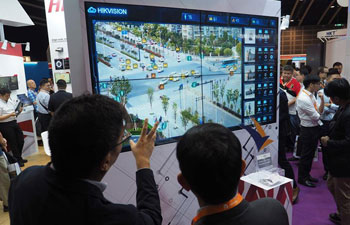
TIANJIN, May 16 (Xinhua) -- Researchers, entrepreneurs, and policymakers gathered at the second World Intelligence Congress in north China's Tianjin Municipality Wednesday to explore AI.
The three-day conference, which kicked-off Wednesday, focuses on new development and policies in AI and gathers participants, including tech firms like Baidu, Alibaba, JD.com, Microsoft, Huawei and iFlytek.
The congress includes forums, exhibitions, and competitions for unmanned cars and drones. The Tianjin municipal government, National Development and Reform Commission (NDRC), and Ministry of Science and Technology are among the organizers of the events.
Lin Nianxiu, deputy director of NDRC, said AI was the most dynamic technological field in the world and the Chinese government highly valued the development of AI. He said China should seize opportunities to raise innovation capabilities in deep learning, smart algorithms and chips, modernize industry with AI technology, and expand opening-up and cooperation with overseas partners.
Wan Gang, chairman of the China Association for Science and Technology, said at the opening ceremony that Chinese companies were world leaders in image recognition, voice translation and behavioral analysis.
"Remarkable achievements have been made in intelligent robotics, unmanned shops, machine translation, shared and driverless vehicles. There are wide applications in the fields of city planning, smart transport, social governance, health, agriculture and national security," he said.
"China has advantages in the speed of AI development and its wide applications, but our weak points are the depth of basic research and originality," Wan said.
He called for strengthening basic research and more input in developing core technology.
Last July, the State Council issued a plan on new generation AI. According to the plan, the AI industry should be a major new growth engine and have improved people's lives by 2020. It set the target of China becoming a major center and world leader for AI innovation by 2030.
"The evolution of new technology is unstoppable," said Indrajit Banerjee, director of the knowledge societies division of the Communication and Information Sector in UNESCO. By 2030, artificial intelligence is expected to generate 16 trillion U.S. dollars for the world economy.
"Chinese companies are very active in developing AI technology and application, and their contribution to AI will be tremendous," he said.
By the end of 2017, China had over 2,000 companies in AI-related industries, according to Ministry of Industry and Information Technology.
Experts and entrepreneurs called for more education to nurture the next generation's talent.
More courses on AI should be introduced to middle and elementary schools in China, said Liu Qingfeng, board chairman of iFlytek, a company that leads in voice recognition technology in China.
"We need talent capable of innovation at the source level and to encourage them to pursue science research, otherwise the next generation of breakthroughs will not happen in China," he said.