 ?
?
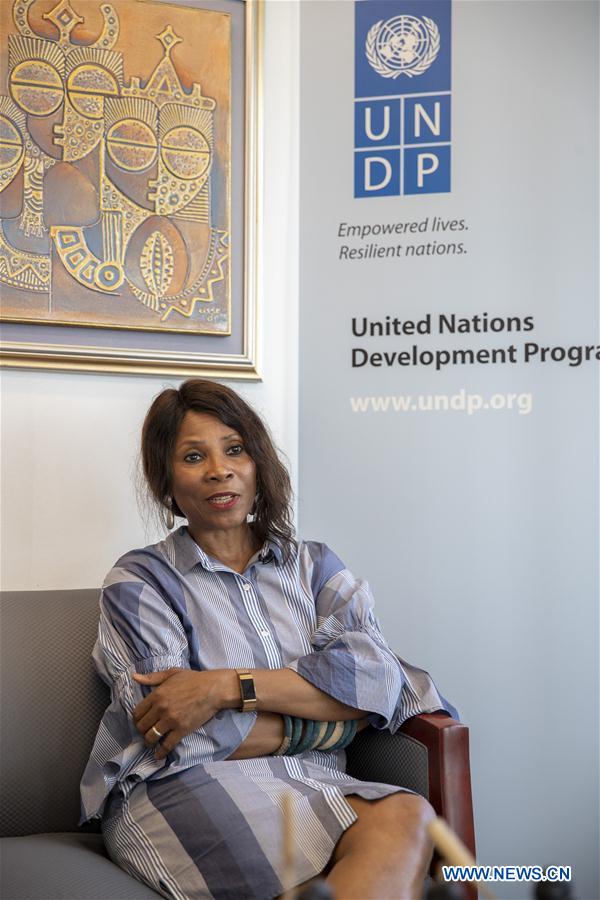
Ahunna Eziakonwa, Assistant Administrator and Director of the Regional Bureau for Africa, United Nations Development Programme (UNDP), speaks during an interview with China's Xinhua News Agency in New York, the United States, Aug. 28, 2018. The Belt and Road Initiative (BRI), if well managed, could significantly reduce costs of doing business for both China and Africa while strengthening ties at the same time, Ahunna Eziakonwa said. (Xinhua/Li Muzi)
UNITED NATIONS, Aug. 30 (Xinhua) -- The Belt and Road Initiative, if well managed, could significantly reduce the costs of doing business for both China and Africa, and strengthen their ties as well, a senior United Nations official said Thursday.
China and Africa have a long history of development cooperation, which has greatly intensified in the past decade, Ahunna Eziakonwa, assistant administrator and director of the Regional Bureau for Africa, United Nations Development Programme (UNDP), told Xinhua.
China's trade, direct investments and loans in Africa have grown multiple folds, Ahunna said.
China accounted for about 25 percent of Africa's global trade in 2015, with African exports to China rising from less than 20 billion U.S. dollars in 2005 to about 110 billion dollars in 2014, she said.
This phenomenon, which contributes to Africa's growth, is also helping to sustain China's growth momentum, Ahunna said, adding that this partnership, if well managed, could catalyze the achievement of the 2030 Agenda for Sustainable Development.
The China-Africa partnership could be used to remove bottlenecks and binding constraints on Africa's development, the UN official said, adding that poor infrastructure, over-dependence on primary commodity, low agricultural productivity and weak investment in technological capacity are among binding constraints on Africa's inclusive development.
Quality infrastructure is needed to move toward industrialization, create jobs for the unemployed youth and women, and bridge the development divide between rural and urban areas, she said.
"Africa must use its partnership with China to leverage quality infrastructural development in such areas as roads, railways, water, telecommunications and energy in order to expand regional connectivity and integration," she said.
"To make this a win-win partnership, it must be driven by African countries' national development priorities, the Programme of Infrastructure Development for Africa and Agenda 2063," she said.
The associated projects should be economically viable and sustainable to Africa, she said.
Africa should accelerate national and regional value chain development through economically viable industrial clusters and special economic zones; close knowledge and technological gaps; and modernize its agriculture in the process toward industrialization, Ahunna said.
She added that climate change and the conservation of its natural resources, in particular the environment, are also important to Africa.
Focusing Africa's partnership with China and others on these strategic issues will put Africa on a sustainable development pathway, and simultaneously help China meet its huge energy, excess domestic capacity and economic needs, Ahunna said.