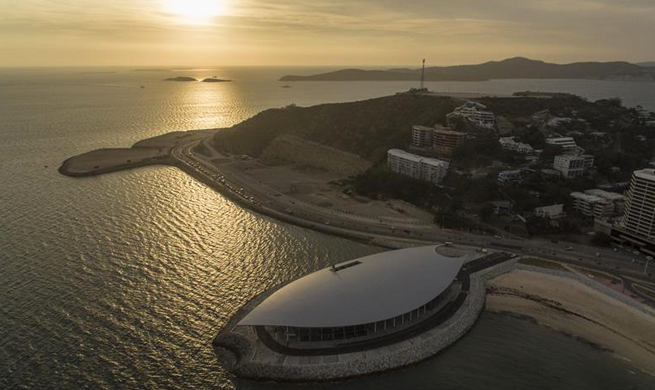
PORT MORESBY, Papua New Guinea, Nov. 12 (Xinhua) -- Leaders from the Asia-Pacific economies are gathering in Port Moresby, the capital of Papua New Guinea for the Asia-Pacific Economic Cooperation (APEC) Leaders' Week on Nov. 12-18.
This is the first time Papua New Guinea holds the event. The week-long get-together is held under the theme of "Harnessing Inclusive Opportunities, Embracing the Digital Future" with three policy priorities -- improving digital connectivity, deepening regional economic integration; promoting inclusive and sustainable growth; strengthening inclusive economic growth through structural reform.
APEC is a regional economic forum established in 1989 to leverage the growing interdependence of the Asia-Pacific. APEC's 21 members aim to create greater prosperity for the people of the region by promoting balanced, inclusive, sustainable, innovative and secure growth and by accelerating regional economic integration.
With a combined population of 3 billion, the 21 APEC economies account for 60 percent of the world's total gross domestic product (GDP) and nearly half of world trade.
APEC is working on areas such as trade and investment liberalization, business facilitation, human security, and economic and technical cooperation, aiming to achieve sustainable growth and prosperity in the Asia-Pacific region.
The notion of establishing a forum for promoting sustainable economic growth and regional cooperation in the Asia-Pacific was first raised by former Australian Prime Minister Bob Hawke in 1989 in response to the growing interdependence of the region and the advent of regional trade blocs in other parts of the world.
The first APEC Ministerial Meeting was held later that year in Canberra, Australia, which marked the official establishment of the mechanism.
In November 1991, the third Ministerial Meeting was held in the South Korean capital of Seoul with the approval of the Seoul APEC Declaration, which finalized APEC's objectives of developing and strengthening the open multilateral trading system, and reducing barriers to trade in goods, services and investment.
In 1994, at the Economic Leaders' Meeting in Bogor, Indonesia, the APEC Economic Leaders' Declaration of Common Resolve was adopted. The declaration pledged APEC's intent to achieve free and open trade and investment by 2010 for industrialized economies, and 2020 for developing economies.
APEC's institutional framework includes the Economic Leaders' Meeting, the Ministerial Meeting, the Senior Officials' Meeting, committees and working groups.
The APEC Secretariat, based in Singapore, was established in 1993 to provide support and services for the forum's activities at various levels.
APEC currently has 21 members, namely Australia, Brunei, Canada, Chile, China, China's Hong Kong, Chinese Taipei, Indonesia, Japan, Malaysia, Mexico, New Zealand, Papua New Guinea, Peru, the Philippines, Russia, Singapore, South Korea, Thailand, the United States and Vietnam.
It has three observers -- the ASEAN Secretariat, the Pacific Economic Cooperation Council, and the Pacific Islands Forum.