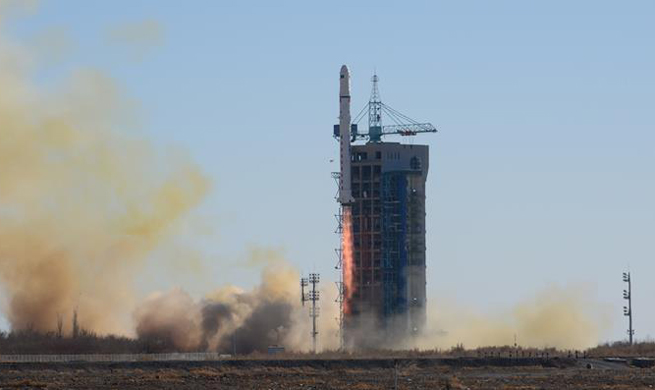
JIUQUAN, Dec. 7 (Xinhua) -- A series of seven small satellites expected to serve for wildlife protection, field emergency rescue, vehicle and ship monitoring and logistics tracing were launched into space at noon Friday.
A Long March-2D rocket, carrying the satellites called the "ladybeetle series," together with two satellites for Saudi Arabia and three other small ones, blasted off from the Jiuquan Satellite Launch Center in northwest China at 12:12 p.m.
The series include Ladybeetle 1, weighing about 100 kg, three CubeSats composed of six cubic units (10*10*10 cm) and three composed of three cubic units.
They are manufactured by Commsat, a Beijing-based private satellite company funded by the Xi'an Institute of Optics and Precision Mechanics under the Chinese Academy of Sciences (CAS).
"We named them 'ladybeetles' as we hope they are down-to-earth, bring qualified services for our clients and have strong vitality," said Xie Tao, founder and CEO of Commsat.
Xie believes that Ladybeetle 1 will realize great commercial prospects due to its advantages in cost and flexibility. "A satellite at a weight of about 100 kg can accommodate more payloads than smaller minisatellites, but will consume much less power when connecting with ground terminals than big satellites weighing over a tonne."
The ladybeetle series will be used to test a closed-loop system for the Internet of Things (IOT), which includes satellites, cloud computing platforms, ground control stations and terminals, said Peng Yuanyuan, co-founder and chief operating officer of Commsat.
"We expect that IOT will mushroom in 2020, with about 20 billion terminals being connected to it. However, only 10 percent of our globe is covered by the ground network, and many things, such as ships, pipelines and wildlife, are scattered across vast areas without the network," Peng said.
The company also plans to launch another four satellites in 2019 and to complete the deployment of a constellation of 72 satellites in 2022, according to Peng.
Peng said the company's satellites will provide data to a sports watch to help monitor the clients' heart rates and temperatures while participating in outdoor sports.
A necklace for giant pandas that have been released back into the wild has been developed, which will be connected to the satellites to provide information about their locations, temperatures and calls.
The satellites can also help monitor the conditions of containers at sea.
In February, Commsat launched China's first shared education satellite, Young Pioneer 1, which shares its data resources with primary and secondary schools and other education institutions equipped with sub-stations in China and provides students with experiences like wireless communication and space photography.
"Commercial aerospace is a burgeoning industry, and we will do our best to realize our dreams," Xie said.