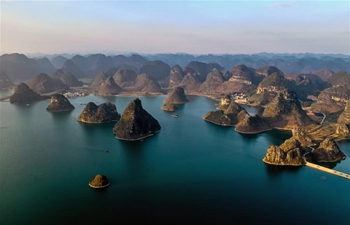
NANNING, Dec. 9 (Xinhua) -- Home to the largest number of ethnic minorities in China, Guangxi Zhuang Autonomous Region will soon mark its 60th anniversary. Here are the latest data about the region, which has seen rapid economic and social developments in recent decades.
POPULATION & ETHNICITY
Established in 1958 as an autonomous region, Guangxi has a population of 56 million, including over 20 million who identify as ethnic minorities. It tops in Chinese provincial-level regions in terms of minority population.
The southern region is heavily inhabited by Zhuang, China's most populous ethnic minority that gave the region its name. Miao and Yao are also major ethnic groups that have inhabited the region since ancient times.
Guangxi has taken pride in the harmonious coexistence of its ethnic communities over the past decades. Ethnic conflicts are rarely heard of.
SHAKING OFF POVERTY
Though bordering the wealthy Guangdong Province and boasting a coastline of 1,500 kilometers, Guangxi is a mountainous region and has long been plagued by poverty. It has been a major front in China's anti-poverty campaign that aims to eradicate absolute poverty by 2020.
Latest government data show that more than 18 million rural residents in Guangxi have been lifted out of poverty in the past 40 years since China launched the reform and opening-up policy, cutting the rural poverty rate from 70 percent in 1978 to 5.7 percent at the end of 2017.
As incomes and medical care improved, the region's average life expectancy rose from 60 years in 1963 to 77 years in 2017.
The region is implementing "high-precision" poverty alleviation -- offering tailored policies to suit different local conditions -- to its remaining 2.67 million poverty-stricken rural residents, mostly living in out-of-reach mountainous villages.
INFRASTRUCTURE BOOM
Improving infrastructure has been accredited for accelerating Guangxi's poverty reduction. Back in 1958, the region operated only three rail lines with a total length of about 1,300 km, which has been extended to 5,191 km as of October 2018, including 1,771 km of high-speed railway.
Highways surpasses 5,000 km in Guangxi, and 91 percent of its counties now have access to expressways.
Guangxi in 2016 became the first ethnic autonomous region in the country to have subways, with about 50 km of metro lines in operation in Nanning, the regional capital. The cities of Guilin and Liuzhou are also building urban rail systems.