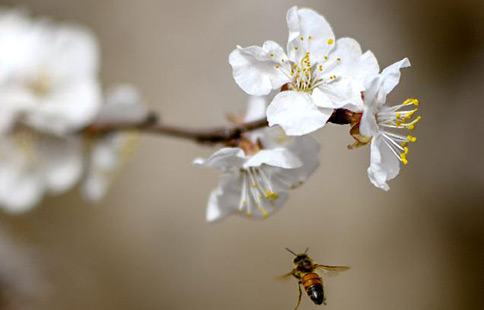
CHANGCHUN, March 24 (Xinhua) -- Wu Zhongshuang, a former lumberjack, has tasted the sweetness from his new job as a beekeeper.
"The Changbai Mountains provide an excellent environment for producing high-quality honey," he said.
Last year, Prince Albert II, head of state of the principality of Monaco visited Wu's bee farm in Huangnihe County, Yanbian Korean Autonomous Prefecture, northeast China's Jilin Province.
Wu not only introduced the whole process of honey-production to the Prince but also shared stories of how he became a beekeeper and a volunteer patroller after working as a lumberjack and hunter.
Since 2011, the Prince Albert II of Monaco Foundation has supported the World Wild Fund's (WWF) protection work of Siberian tigers in population monitoring, prey restoration and anti-poaching.
In 2011, the WWF and Huangnihe forestry bureau worked together and carried out the beekeeping project, turning lumberjacks like Wu into beekeepers, aiming to stop cutting down trees and protect the living environment of tigers. A cooperative and honey-producing workshop have also been established.
"Thanks to the project, I have a great new job and earn about 60,000 yuan (about 8,950 U.S. dollars) a year," Wu said.
To better protect the tigers, Wu and his fellow villagers have also become volunteer patrollers to remove tiger traps.
Since 2016, an annual patrolling contest has been held to help patrollers improve their skills and learn about the latest patrol equipment.
The WWF has also been supporting the construction of the Northeast China Tiger and Leopard National Park by installing infrared cameras, building a prey breeding base, as well as holding activities to engage the public in Siberian tiger protection.
"The Albert II foundation will continue to support WWF's protection projects of Siberian tigers, and work with Jilin and Heilongjiang provinces to push forward closer cooperation between China and Russia," said Liu Peiqi, the head of WWF's Northeast China program.
Siberian tigers, otherwise known as Amur or Manchurian tigers, mainly live in eastern Russia, northeast China and the northern part of the Korean Peninsula. As one of the world's most endangered species, less than 500 Siberian tigers are believed to live in the wild, with only around 20 in China.
Thanks to the intensified protection efforts, the population of Siberian tigers and Amur leopards has been on the rise. By the end of 2017, at least 27 adult tigers and 42 Amur leopards were reported in Jilin Province.