by Xinhua writers Liu Tian, Lin Hao
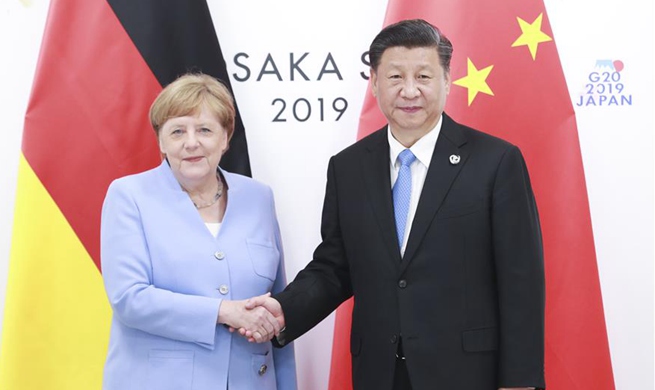
OSAKA, Japan, June 29 (Xinhua) -- The Group of 20 (G20) Osaka summit concluded here Saturday with leading economies' leaders agreeing to work together to foster global economic growth.
According to a declaration issued after the summit, the G20 members will "strive to realize a free, fair, non-drimination, transparent, predictable and stable trade and investment environment, and to keep our markets open."
"We reaffirm our commitment to use all policy tools to achieve strong, sustainable, balanced and inclusive growth, and safeguard against downside risks, by stepping up our dialogue and actions to enhance confidence," the declaration said.
Based on the message from the Osaka summit, the G20, a mechanism founded to group broader parties to share their recipes for aiding a fragile global economy, has made some progress this time in bridging differences among the members by highlighting their will towards strong and sustainable growth and development.
Ahead of the summit, observers expressed their concerns that the G20 may encounter a challenge from within as unilateralism is making cracks inside the multilateral grouping at a time when more collective efforts are needed to address the demanding task of development.
In 1999, the G20 came into being because the world's seven industrialized countries were unable to fully deal with the aftermath of the Asian financial crisis.
Since 2008, leaders of the G20 have met regularly to enhance the group's capacity to deal with crises and new development in the global economy.
In Osaka, the G20 countries helped the mechanism overcome a possible split. Yet looking ahead, challenges brought by the unprecedented development in science and technology require the G20 members to strengthen solidarity to pinpoint more innovative and inspiring cooperation and coordination among them, as well as send a strong message to the rest of the world that the world's leading economies are on the same page to meet global issues.
Basic issues of the world economy still need to be resolved after the G20 summit, as the global economy hasn't yet recovered from the financial crisis a decade ago. What is worse, it is hit again by uncertainties including trade frictions.
The international community should keep in mind that trade tensions have put the decade-long world trading system in jeopardy by breaking the global supply chain and weakening market confidence restored in the past years, leaving emerging markets more vulnerable to economic headwinds.
More importantly and urgently, the multilateral consensus and commitment reached in Osaka should be concretely implemented by the G20 members to make progress in handling challenges.
For decades, China has committed itself to opening up and engaging with the international community by playing a more constructive role in different multilateral organizations. With its growing economy, China is sharing its development with the rest of the world.
While upholding multilateralism, China is opening itself up more to the rest of the world with rounds of new measures to boost interactions with others, aiming for shared progress and prosperity.
It needs to be emphasized that multilateralism is still the primary value to dispel challenges in the world as a deeply interwoven community with a shared future vision will definitely be stronger when facing uncertainties.