 ?
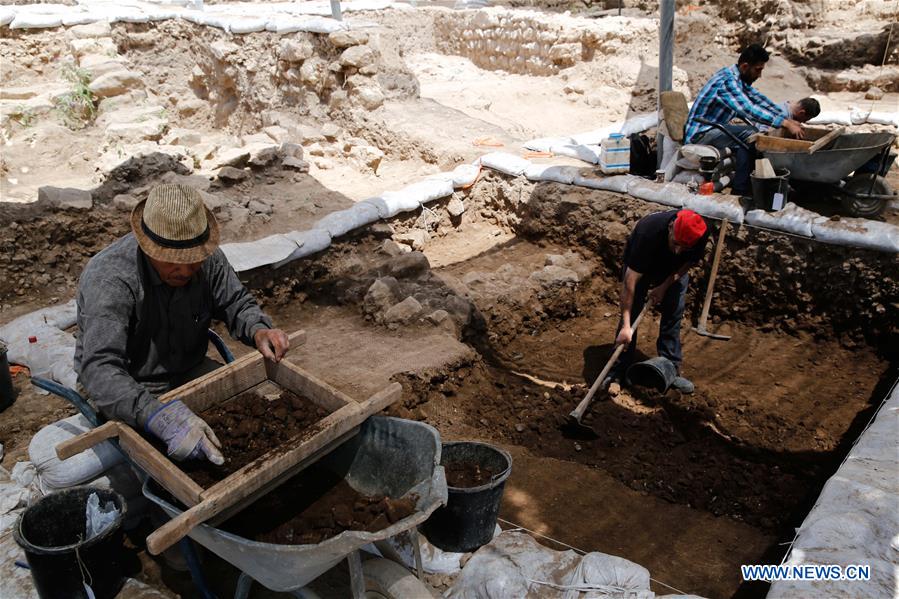
?Employees of the Israel Antiquities Authority work at the site of a 9,000-year-old prehistoric settlement in Motza, 5 km west of Jerusalem, July 16, 2019. Archeologists in Israel said on Tuesday that they have discovered a huge prehistoric settlement outside Jerusalem dating back to 9,000 years ago. The Israel Antiquities Authority, which oversees the excavation, issued a statement saying that the settlement is one of the largest of its kind in the region from the Neolithic Period, or the New Stone Age. (Xinhua/Gil Cohen Magen)
JERUSALEM, July 16 (Xinhua) -- Archeologists in Israel said on Tuesday that they have discovered a huge prehistoric settlement outside Jerusalem dating back to 9,000 years ago.
The Israel Antiquities Authority, which oversees the excavation, issued a statement saying that the settlement is one of the largest of its kind in the region from the Neolithic Period, or the New Stone Age.
"Thousands of arrowheads, pieces of jewelry and figurines produced by ancient people of the site have been unearthed during the excavation," the statement said.
The site, built on the banks of the Sorek stream, is located 5 km west of Jerusalem.
Hamoudi Khalaily, co-director of the excavation, said that at least 2,000-3,000 residents had lived in the settlement.
The archeologists found large buildings at the site, including living rooms, public facilities and places of ritual.
Alleys connecting the buildings show the residents of the settlement had advanced level of planning, the researchers said.
A huge quantity of legumes, especially lentils, were found in some of the buildings.
"The fact that the seeds were preserved is astonishing in the light of the site's age," said the researchers. "This finding is evidence of an intensive practice of agriculture."
Burial pits have also been exposed where the ancient residents placed useful or precious objects.
The researchers found inside the tombs unique objects made of an unknown type of stone and objects make of obsidian or volcanic glass from Anatolia, as well as seashells brought from the Mediterranean Sea.
According to researchers, the exposure of the site "awakens extensive interest in the scientific world, changing what has been known about the Neolithic Period in that area."