




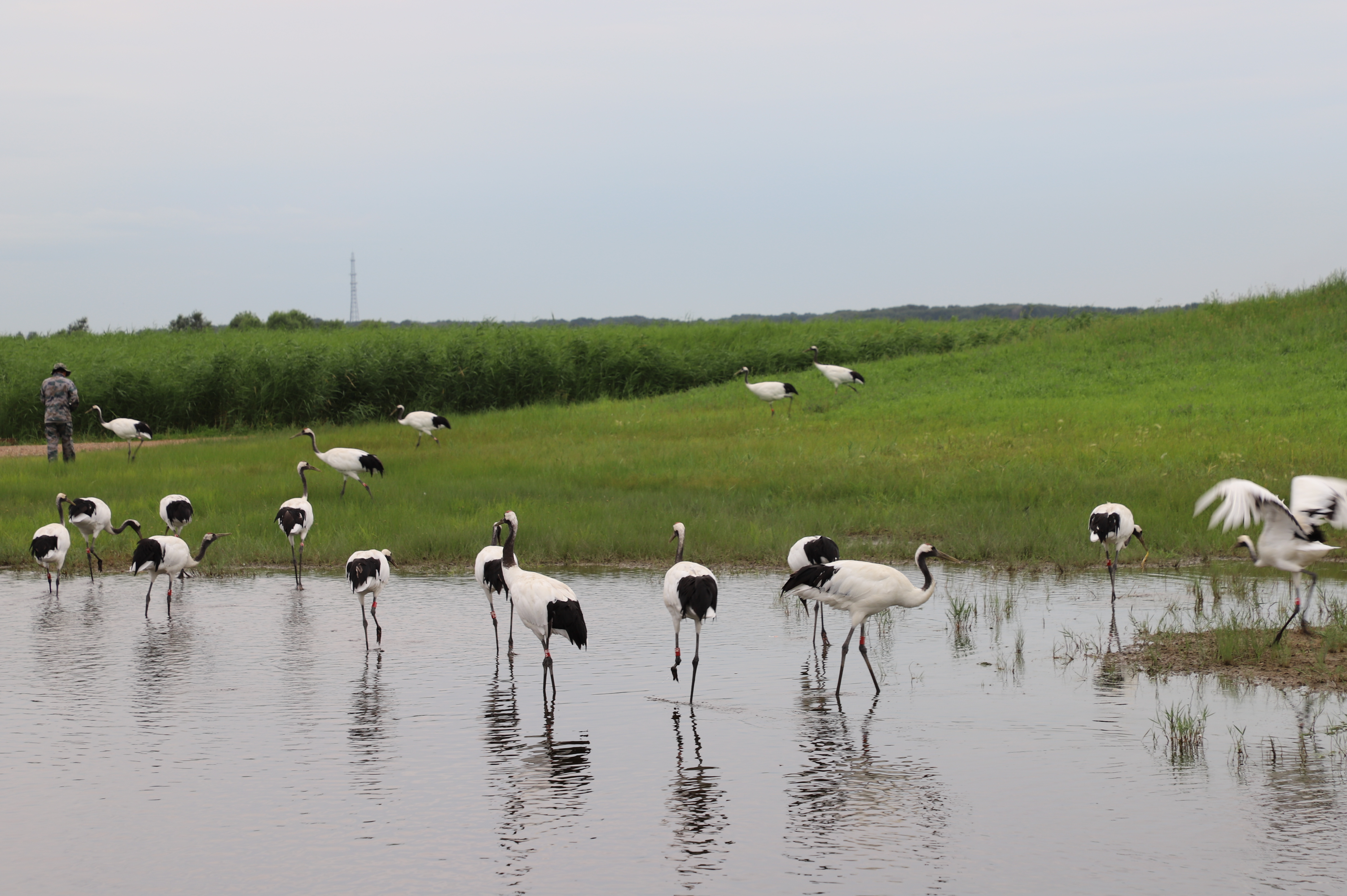
Red-crowned cranes drink water and search for food at Zhalong National Nature Reserve in Qiqihar, northeast China's Heilongjiang Province, July 23, 2019. (Xinhua/Sun Xiaoyu)
How can AI help protect endangered species? Experts working to protect Siberian tigers and leopards in NE China may have the answer...
HARBIN, July 30 (Xinhua) -- An artificial intelligence-enabled (AI) monitoring platform designed to help protect wildlife has been jointly established by an animal protection administration and technology groups, local authorities announced Tuesday.
The AI big data real-time monitoring platform, co-developed by the Feline Research Center of National Forestry and Grassland Administration, the Harbin Institute of Technology (HIT) and HIT Big Data Group, is expected to support research on ecological systems, animal populations and individual animals through advanced technologies. Those technologies include artificial intelligence, machine learning and neuro-linguistic processing.
Internet of Things, big data and intelligent machine vision technology will also enable the platform to establish individual recognition models with main recognition elements such as animal posture, gait, color and fur pattern.
Li Fuquan, an official with HIT Big Data Group, said the platform will be preliminarily applied to track and monitor endangered Siberian tigers, leopards and their prey. Forest zones in the northeastern provinces of Heilongjiang and Jilin, as well as border areas between China and Russia, are the main habitat areas for Siberian tigers and leopards.
The platform is expected to provide cross-border services for wildlife protection, according to Li.
A database for Siberian tigers and leopards will be established to help study the relationship between the changes in the ecological environment and the development of the species.
"Data can help us better understand wildlife, and more technologies are expected to be introduced to study and protect wild animals," Li added.

