



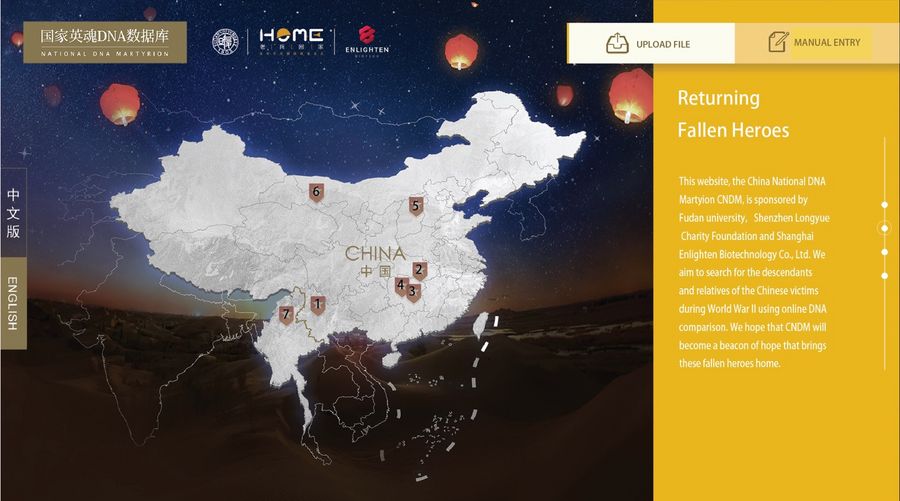
A webpage of China National DNA Martyry, a DNA database built by Fudan University researchers to help Chinese families find missing relatives. (Photo provided by Fudan University)
After decades of searching, the martyr's family finally found the remains thanks to a breakthrough in DNA testing technology that enables researchers to detect more genes simultaneously with shorter and more precise DNA amplicons.
SHANGHAI, Sept. 4 (Xinhua) -- More than 70 years after he died fighting the Japanese invasion of China, soldier D02324 has his name again -- and his family.
The identification of martyr Zou Kaisheng came about after a breakthrough in DNA testing technology at Shanghai's Fudan University.
For Zou's granddaughter, Zhang Jihong, the discovery closed a long chapter of her life during which her mother spent decades searching for the hero, whom Zhang and her mother had never met.
"We'd turned over every stone without success, and then last April we were informed the remains might be buried in Shanxi Province," said Zhang.
The family left for a village in Pingyao County, where a tomb contained the bodies of unknown soldiers, and they brought some of the remains back to Shanghai for DNA testing.
After a month studying Zhang's chromosomal profile and a male paternal relative's Y-chromosomal profile, researchers confirmed the remains belonged to her grandfather.
"We were over the moon with the results," said Zhang.
DNA analysis is the only practical method of identifying remains, but current methods rarely obtain useful data from skeletal remains after decades of contamination by microorganisms and inorganic substances, such as metal pollutants from corroded weapons.
But the Fudan University researchers have invented a new and more efficient test method for identification.
They collected the remains of 572 martyrs at seven battle sites found by Chinese government and public organizations from 2015 to 2018.
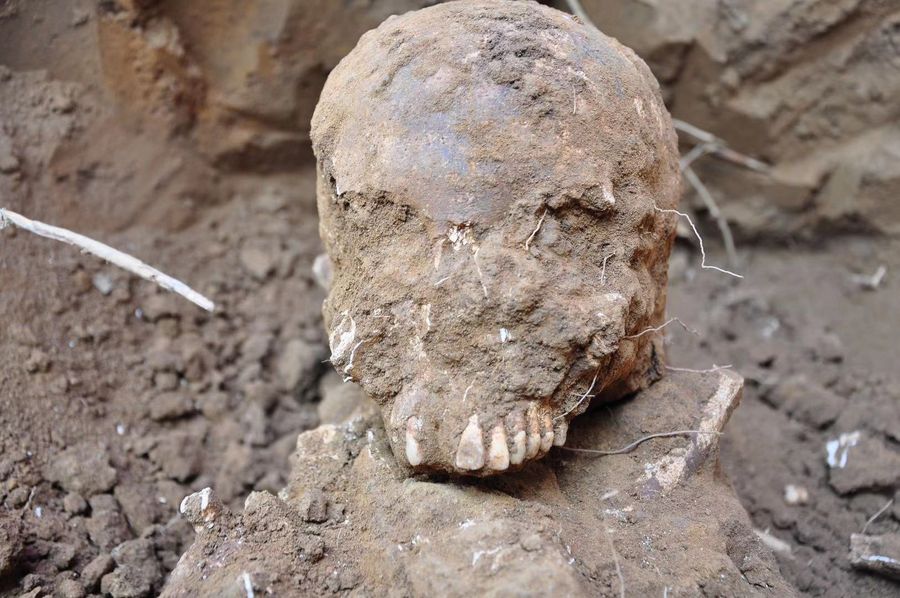
One of the remains found at a tomb of unknown soldiers in Pingyao County, north China's Shanxi Province. (Photo provided by Fudan University)
Research leader Wen Shaoqing said soil microorganisms were the main component of the remains.
Genetic material was degraded severely, making the DNA segments very short. "Their DNA segment length is just a hundred thousandth, or even shorter, of that of living people," Wen said.
The shorter the segment is, the fewer identifiable DNA characteristics there will be.
In the study, researchers extracted DNA from bones and teeth using an improved procedure with additional purification to avoid contamination.
They updated the sequencing technology to detect more genes simultaneously with shorter and more precise DNA amplicons, or segments of DNA that undergo artificial amplification and contain targeted gene variants.
Wen said the improvements were developed during previous genetic studies of East Asian populations.
The new method can detect maternal and paternal lineage, gender, and features that distinguish ethnic groups such as those of China, Japan and the Republic of Korea.
The study was published in the Journal of Human Genetics.
Wen and his team have identified 331 unknown Chinese soldiers from World War II and established a national DNA database to help Chinese families find missing relatives.
They are still improving the sequencing technology and calling for more people to donate DNA data.
"The data pool is a beacon illuminating the martyrs' return home," Wen said.
