



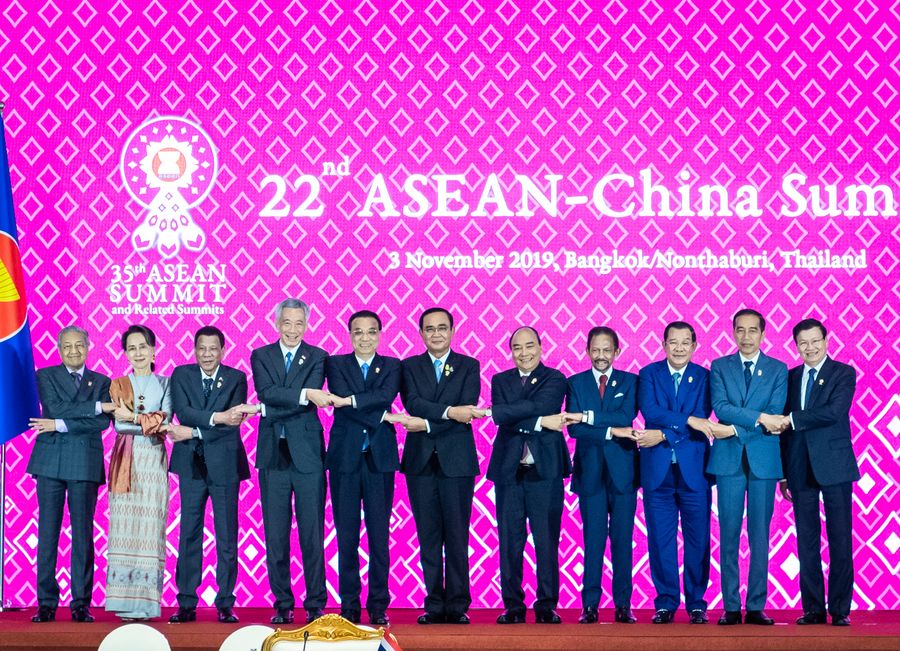
Chinese Premier Li Keqiang (5th L) poses for a group photo with other leaders at the 22nd China-ASEAN (10+1) leaders' meeting in Bangkok, Thailand, Nov. 3, 2019. (Xinhua/Zhai Jianlan)
ASEAN and China reaffirmed their strong commitment to upholding a rules-based, open, transparent, non-discriminatory, and inclusive multilateral trading system as embodied in the World Trade Organization.
Both sides also agreed to stand firm against growing protectionist and anti-globalization sentiments.
BANGKOK, Nov. 3 (Xinhua) -- The 10-member Association of Southeast Asian Nations (ASEAN) and China pledged on Sunday to synergize development plans and work together to promote connectivity in the region, according to a statement issued at the 22nd ASEAN-China summit in the Thai capital.
According to the ASEAN-China Joint Statement on Synergizing the Master Plan on ASEAN Connectivity (MPAC) 2025 and the Belt and Road Initiative (BRI), both sides recognized that synergies between MPAC 2025 and the BRI will contribute to regional connectivity, peace and stability, economic prosperity and sustainable development.
The MPAC 2025 focuses on five strategic areas, namely sustainable infrastructure, digital innovation, seamless logistics, regulatory excellence and people mobility, while the five major cooperation priorities of the BRI are policy coordination, connectivity of infrastructure, unimpeded trade, financial integration and closer people-to-people ties.
All 10 ASEAN member states have signed bilateral agreements with China on BRI cooperation.
ASEAN and China reaffirmed the commitment to enhancing regional connectivity, while noting the principles of openness, transparency, inclusiveness and ASEAN centrality, the statement said.
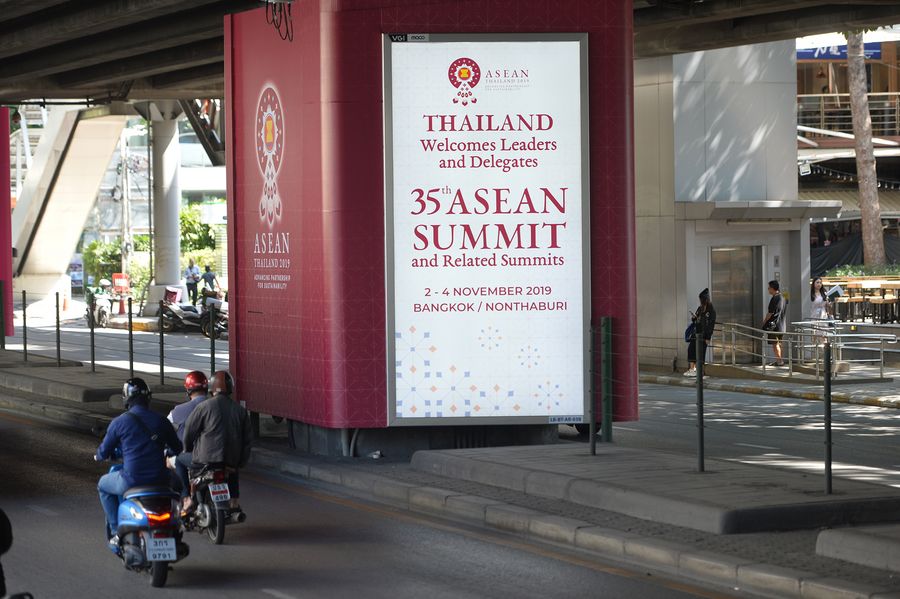
People pass by a poster of the 35th ASEAN summit and related summits in Bangkok, Thailand, Oct. 30, 2019. (Xinhua/Rachen Sageamsak)
China was encouraged to "actively support the development and financing of ASEAN infrastructure projects and promote connectivity cooperation in areas such as railways, highways, port and harbors, airports, power and communication, for building better business and investment environment," it said.
Proposed in 2013, the Silk Road Economic Belt and the 21st Century Maritime Silk Road Initiative aims to build trade and infrastructure networks connecting Asia with Europe and Africa on and beyond the ancient Silk Road routes.
According to the statement, both sides also reaffirmed their strong commitment to upholding a rules-based, open, transparent, non-discriminatory, and inclusive multilateral trading system as embodied in the World Trade Organization, and standing firm against growing protectionist and anti-globalization sentiments.
They will also leverage on the opportunities brought by the Fourth Industrial Revolution and expand cooperation in areas including innovation, smart city development, digital economy, digital supply chain and work force, artificial intelligence, big data, internet of things (IOT), information and communication technologies, e-commerce and micro, small and medium enterprises (MSMEs).
People-to-people connectivity and policy dialogues will also be strengthened, it said. In the statement, both sides also reaffirmed the commitment to concluding the Regional Comprehensive Economic Partnership (RCEP) negotiations within this year.
Established in 1967, ASEAN groups Brunei, Cambodia, Indonesia, Laos, Malaysia, Myanmar, the Philippines, Singapore, Thailand and Vietnam.■
