



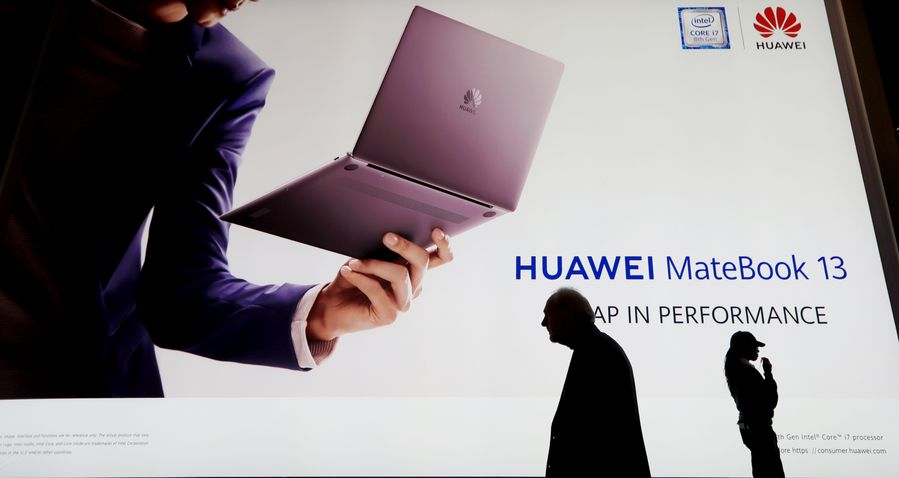
Visitors walk by an advertising screen of Huawei during the Consumer Electronics Show (CES) in Las Vegas, the United States, Jan. 8, 2019. (Xinhua/Li Ying)
The response came after the U.S. Federal Communications Commission listed Huawei and its industry peer ZTE as so-called "threats to national security" and thus barred companies from using money from its Universal Service Fund (USF), which is 8.5 billion U.S. dollars every year, to purchase technology from the two Chinese companies.
WASHINGTON, Nov. 22 (Xinhua) -- Chinese telecom giant Huawei said Friday that the U.S. government's order to bar U.S. telecom companies from using federal funds to buy products from Huawei is "unlawful."
The response came after the U.S. Federal Communications Commission listed Huawei and its industry peer ZTE as so-called "threats to national security" and thus barred companies from using money from its Universal Service Fund (USF), which is 8.5 billion U.S. dollars every year, to purchase technology from the two Chinese companies.
The U.S. government made the decision "based on selective information, innuendo, and mistaken assumptions," and it provided "no evidence that Huawei poses a security risk," according to a statement issued by Huawei.
"These unwarranted actions will have profound negative effects on connectivity for Americans in rural and underserved areas across the United States," said Huawei.
"Many carriers rely on Huawei for its high-quality, market-leading, and cost-effective equipment and services," the company said.
On Monday, the U.S. Department of Commerce extended a temporary license loosening restrictions on business deals with Huawei for another 90 days.
"The Temporary General License (TGL) extension will allow carriers to continue to service customers in some of the most remote areas of the United States who would otherwise be left in the dark," said U.S. Secretary of Commerce Wilbur Ross in a statement on Monday.
"Without access to those solutions, these carriers will lose their ability to provide reliable and high-speed telecommunications and internet services. Rural schools, hospitals, and libraries will feel the effects," according to Huawei. ■
